Opening Story: The Graduate's Moment
When Maya walked across the stage to receive her bachelor's degree in psychology, her family cheered, her friends snapped photos, and her professors congratulated her. It should have been one of the happiest days of her life. Yet as she clutched the diploma, a quiet worry overshadowed the celebration.
She studied hard. She learned a lot. But as the event hall cleared, she found herself asking the question that thousands of new graduates' whisper to themselves every year.
Did I choose the right major? What job does this lead to?
Maya was not alone. Many students move through college focused on quizzes, midterms, and final projects only to arrive at graduation, realizing that they are less certain about how their degree connects to the job market than they expected. The excitement of completing an education blend with anxiety over employability. The pressure to make the right moves, to land the right job, and to prove that the investment in college will pay off becomes overwhelming. Students know the cost of a degree is rising. What they want to know is whether the return will match the investment they and their families have made.
This emotional moment is the quiet crossroads between learning and earning. And too many students reach it unprepared.
The Shifting Landscape of Career Readiness
The world of work has become intensely dynamic. Industries are innovating faster than academic programs that can update curricula. Job roles evolve; employers expect evidence of skills more than ever, and the path from college to career has become much less linear than it once was.
Research tells the story clearly.
According to the National Association of Colleges and Employers (NACE), employers consistently rank critical thinking, communication, teamwork, and career readiness competencies as essential, yet many graduates are unable to articulate these skills confidently during interviews. Strada Education Network has found that millions of graduates' experience underemployment in their first job after college and remain underemployed five and even ten years later. The Georgetown Center on Education and the Workforce reports that the returns on a degree vary significantly depending not just on the major but on how the student leverages skills, internships, and professional experiences. The World Economic Forum adds that the most in-demand jobs increasingly value cross-disciplinary power skills such as problem solving, systems thinking, and digital fluency.
The gap is not a lack of ability or potential. Students are learning valuable skills across majors. The challenge is that the link between coursework and careers is not always visible to them.
Students often believe there is a direct, predefined path between a major and a specific job title. In reality, the modern marketplace rewards combinations of skills. At the same time, higher education is facing growing expectations to demonstrate clear returns on investment. Students and families are asking whether the cost of a degree leads to financial stability and professional growth. Underemployment carries a real financial burden, delaying wealth building and career momentum. Institutions that fail to align learning with workforce demand risk eroding trust in the value of a degree.
Higher education has an opportunity here. Not to replace learning with job training, but to make visible the relationship between learning and opportunity.
AI as the Bridge from Learning to Earning
Imagine if every student had a personal guide from the first semester to the first job offer. Not a system that dictates choices, but a companion that illuminates possibilities.
Artificial intelligence is making this possible.
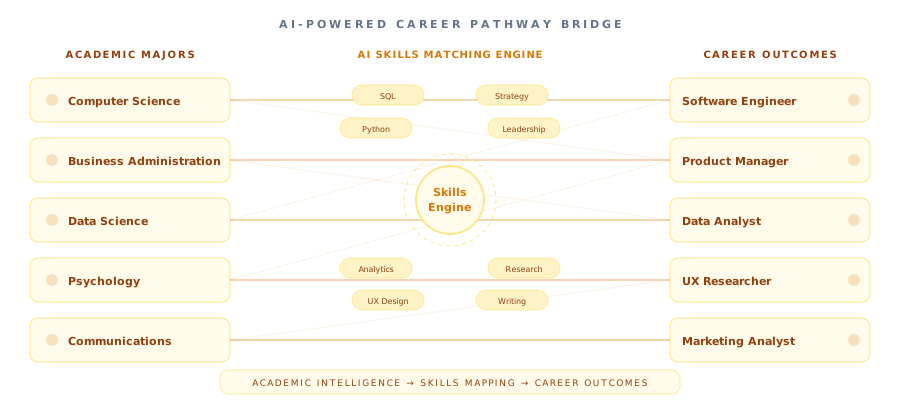
AI can now analyze what a student is learning in courses, labs, projects, internships, volunteer activities, and extracurricular clubs. It can identify the skills being built along the way and compare those skills to career pathways, job descriptions, industry trends, and labor market data.
Rather than waiting until senior year to introduce resumes, job titles, and networking, AI can support a very different model:
teach → map → connect-to-career
This shift ensures the pathway from learning to earning is visible the entire way. When students can see how every course and project contributes to employability, the value proposition of education strengthens. They understand earlier how their academic choices set up stronger wage outcomes and long term career mobility.
And most importantly, it does not replace advisors or career coaches. It empowers them to focus on deeper conversations by eliminating guesswork.
Career Pathways in Action: From Courses to Careers
To understand the power of an AI-driven approach, imagine a student dashboard that evolves throughout the academic journey.
As the student progresses, the AI companion continuously interprets their learning and updates insights across several modules:
1. Skills-to-Roles Matching
AI reviews assignments, projects, and completed courses to identify skills. It then shows which careers or job titles commonly require those skills. A sophomore can see early on that they are building communication, qualitative research, and data storytelling skills that align with fields like UX research, policy analysis, or marketing analytics.
2. Micro-Credential and Gap Recommendations
Instead of discovering too late that an industry requires certain qualifications, students get suggestions at the right time. For example, a psychology major interested in UX could receive personalized nudges recommending a usability testing micro-credential or a human-computer interaction elective.
3. Experience Suggestions and Real-World Pathways
AI can match skills and interests with suitable internships, campus opportunities, capstone projects, volunteering, and experiential learning programs. Students who feel unsure about what type of experience would matter most can finally move forward with confidence.
4. Careers Exploration Dashboard
Students can explore how different job titles connect to skill sets they already have, and those they can build. They can compare median salaries, geographic demand, day-to-day responsibilities, and advancement trajectories. Careers no longer feel like secret paths that only a few know. This clarity is directly linked to economic outcomes. When students pursue aligned experiences sooner, they graduate with portfolios and marketable skills that lift first job placement rates and salary trajectories. The return on a college investment becomes not only measurable but personal and empowering.
Example Pathways Across Majors
Some of the most empowering journeys come from unexpected intersections. For example:
| Academic Background | Career Pathway | Skills that Connect the Dots |
|---|---|---|
| Psychology | UX Research | Interviewing, qualitative analysis, empathy, behavioral patterns |
| Biology | Regulatory Affairs | Research methods, compliance, precision documentation |
| English | Content Design | Writing, audience awareness, storytelling, digital product thinking |
| Sociology | People Analytics | Data interpretation, cultural insight, data ethics |
| Computer Science | Product Management | Systems thinking, feature prioritization, technical fluency, teamwork |
| Business | Revenue Operations | Analytics, forecasting, CRM fluency, process optimization |
Students see that their major is not a box. It is a base. The bridge between their academic experience and the workforce becomes visible instead of mysterious.
Institutional Impacts: Equity, Efficiency, Lifelong Learning
When academic programs and career services leverage AI to make skills and pathways transparent, campuses see transformation on several fronts.
Earlier Clarity and Reduced Anxiety
Students who understand career trajectories earlier make more intentional choices. They select courses strategically. They pursue internships sooner. They approach networking with purpose instead of panic.
More Equitable Access to Career Guidance
Not every student visits the career center. First-generation students, working students, and commuter students often have less time to seek help. AI removes the barriers of time and location by delivering guidance whenever and wherever students need it.
Advisors and Coaches Become Even More Crucial
AI does not replace advising. It augments it. Instead of spending time helping students translate coursework into skill language or searching job databases manually, advisors can focus on what humans do best: mentoring, building confidence, and supporting personal transformation.
Alignment With Employer Expectations
ROI matters to institutional leaders too. Clear employment outcomes drive enrollment confidence, improve retention, and meet growing accountability pressures from policymakers and accreditors. When institutions improve career placement and earnings outcomes, they strengthen their competitive position and demonstrate measurable value.
A Foundation for Lifelong Learning
The degree is no longer the end of the journey. As automation reshapes industries and new jobs emerge, institutions have an opportunity to support graduates over decades. The same AI mechanisms that help students find their first role can later help them upskill, pivot industries, or explore leadership opportunities. This role positions higher education not as a one-time transaction, but as a lifelong career partner.
Conclusion: Purposeful Learning for the Next Decade
When Maya walked across that stage, she deserved more than hope. She deserved clarity, confidence, and knowledge that her investment in education was the first step in a powerful career journey.
That future is now within reach.
By bridging learning and employability through AI, higher education can move from a model where students finish degrees and then figure out their next steps, to one where career exploration and skill development unfold continuously during the academic experience. Every student can see their strengths, understand their pathways, and identify opportunities with confidence rather than guesswork.
Education is one of the largest investments a person will ever make. This transformation helps ensure that investment delivers not only knowledge but outcomes, economic mobility, and lifelong opportunity.
Higher education has always been about empowering human potential. AI simply gives us the tools to illuminate that potential earlier, more equitably, and more purposefully.
The next decade belongs to institutions that embrace this shift. Not because technology demands it, but because students deserve it. The world of work will continue to change rapidly. Students need support not just when selecting a major or preparing resumes, but throughout their evolving careers.
AI makes that possible. It builds a world where students move from major selection to skill discovery to job offers and beyond, guided always by insight, clarity, and opportunity.
In that world, education does not simply prepare students for work. It stays with them throughout life, as a partner in growth and a generator of enduring returns.