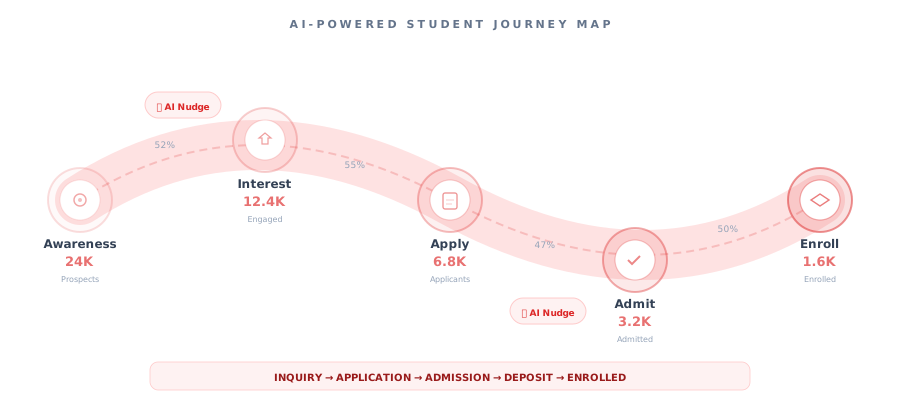
Opening Scene: The Applicant's Journey
It usually begins long before the first deadline.
A high school senior sits at a dining table late in the evening. The laptop is open, papers are scattered, and the glow of the screen reflects the mix of excitement and stress that has become part of daily life. There are tabs open for application portals, scholarship essays, fee waivers, major requirements, and campus tour schedules. The Common App is complete for two colleges and half complete for several others. A phone alarm reminds her to request transcripts. Another reminds her to finish the supplemental essays.
She wonders silently if universities see her as a real person or just another application number. She worries that choosing the wrong major might lead to extra semesters and extra costs. She is not sure whether the email invites to events are tailored to her or sent to thousands. She wants a college that understands her strengths and her story.
The admissions journey is not only procedural. It is emotional. It is filled with hope and uncertainty. It is shaped by questions that are hard to articulate. Many students have counselors, parents or college-savvy friends to guide them. Many others do not. The difference between those two experiences influences not just applications but confidence and long-term success.
Inside the Admissions Office: Complexity and Pressure
Meanwhile, in an admissions office on a busy campus, the pressure looks very different.
Application volume keeps rising according to NACAC's State of College Admission reports. Students are applying to more colleges than ever before, which drives competition without increasing the number of actual college-bound students. Yield becomes harder to predict. Melt increases even after students commit. The transfer market is growing, but transfer pathways are difficult to explain and evaluate. Accessibility expectations are higher, and the timeline to engage a student is shorter than in previous years.
Staff are committed and student-centered but face difficult realities.
They are expected to personalize outreach at scale
They are responsible for navigating multiple enrollment pipelines
They are asked to accomplish more with fewer hands
They must respond quickly to students who expect immediate clarity
Most enrollment offices are incredibly strategic, and mission driven. Yet personalization at scale is nearly impossible without modern data foundations. Human effort alone cannot sustain meaningful engagement with tens of thousands of unique journeys.
A Turning Point: Unified Data to Understand Students Better
For years, enrollment leaders have imagined a world where every action and signal from a student could be seen in context.
- Which email messages they opened
- Which majors they researched on the website
- Whether they attended virtual events
- Whether a parent called the financial aid office
- Whether they paused engagement after submitting an application
- Whether they are transfer students who need clarity on credit applicability
This information exists. The challenge is that it lives in different places.
The CRM holds communication data. The SIS contains academic history. The application platform holds program choices and submissions. The website contains intent signals. The call center tracks conversations. None of these systems were originally built to share context in real time.
That is beginning to change.
Unified Campus Data Hub
A unified campus data hub built on secure and scalable architecture links these systems together. When CRM, SIS, web analytics, transcript evaluation and application records feed a single analytical foundation, admissions teams gain a new ability. They can finally understand where each student is on the decision-making journey and why.
The result is not automation of decision making. It is an amplification of human support.
Unified data reveals patterns.
- Students who begin to disengage long before they stop responding
- Students whose chosen major does not align with their academic interests
- Transfer applicants who would enroll faster if their credit applicability was visible
- Prospects who believe they will not qualify for aid and therefore never apply
- Students who need reassurance rather than reminders
Understanding replaces assumptions. Admissions become proactive instead of reactive.
AI Companions: Personalizing Support for Students and Staff
Once unified data is accessible in real time, a new category of support system becomes possible. AI admissions companions sit at the intersection of analytics and the student experience. They are not generic chatbots that answer static questions. They are personalized assistants that understand context.
From the Student Perspective
A student signs in to the admissions portal and interacts with an AI companion that already understands their stage in the process.
- It reminds them of documents or deadlines in a gentle and supportive way
- It suggests majors that align with their strengths and interests
- It explains scholarship eligibility without requiring a search through dozens of pages
- It shows transfer students how credits apply depending on major choice
- It offers guidance on essay prompts if they request it
- It checks in when engagement drops instead of waiting for silence
Students feel supported rather than overwhelmed. They feel that the institution knows who they are and cares about their success before they ever set foot on campus.
From the Admissions Staff Perspective
AI companions do not replace human counselors. They clear the path so counselors can do their most meaningful work.
Unified data and signal-based dashboards allow staff to:
- Prioritize students who need personal outreach
- Focus on students who are likely to succeed but stalled in requirements
- Reduce avoidable melt through caring and timely intervention
- Personalize engagement campaigns based on real signals, not generic segmentation
Counselors move beyond paperwork and process, dedicating their time to empowering students and supporting thoughtful human decisions.
Ethical and Operational Considerations
The value of AI in admissions is significant, but it must be governed carefully to avoid harm and maintain trust.
Transparency
Students should know when AI is being used and why.
Consent
Students should be able to control whether their data is used for personalized recommendations.
Fairness
Predictive models must be validated to avoid reinforcing demographic or socioeconomic bias.
Explainability
Students and staff should be able to understand why a suggestion or prediction is made.
Privacy
Student data must remain secure, and access limited to clearly defined purposes.
AI should never create barriers or reinforce inequities. It should widen opportunities and help every student navigate admissions with clarity and confidence.
A New Vision: Admissions as a Journey of Belonging
For decades, admissions have been framed as a funnel. A large pool of prospects narrows until a final group enrolls. That framework influences language, workflow, and technology.
A new era is taking shape.
With modern data foundations and AI companions, admissions can become the beginning of a lifelong relationship rather than a one-way evaluation process.
The student who once sat alone at the dining table surrounded by deadlines and unanswered questions no longer has to navigate the journey alone. They receive guidance that is timely and personal. They feel understood and supported instead of overlooked and invisible. They feel welcome before they even arrive. They choose a college not only because it accepts them but because it understands them.
This is the promise of AI-driven admissions.
Not efficiency. Not automation. Belonging.