Introduction: AI as a Companion, Not a Replacement
AI in higher education is not about replacing people or automating relationships away. It is about strengthening the relationships that already exist: between admissions officers and prospective students, between counselors and the students they serve, between departments that need to collaborate better. AI companions handle the mechanical burden so your people can do what they do best: connect.
The Volume Trap: More Communication, Less Connection
Here is what is happening on most campuses right now: admissions teams are sending enormous volumes of outreach (emails, mailers, texts) and most of it goes ignored. Not because students do not care, but because the communication feels generic. It does not speak to their interests, their background, or their questions. Most students feel college outreach is not personalized to them. Many have not spoken to an admissions officer at all in the past year.
On the operations side, finance leaders acknowledge that AI could transform their workflows, but most institutions are still in exploration mode. Running small pilots, attending conferences, reading reports. Very few have moved anything into production. The biggest barrier is not budget or technology. It is cultural. Staff are not sure what changes, what stays, and whether this is just another initiative that overpromises and underdelivers.
Meanwhile, the external environment keeps tightening. Enrollment is volatile. Federal funding is shifting. Regulatory requirements keep growing. And the students showing up on campus have grown up with AI in their daily lives. They expect every interaction, including with their university, to feel intelligent and responsive.
Institutions need to do more with less, but the answer is not simply buying software. It is rethinking how AI fits alongside the people who already run the institution. That is the shift from AI as a tool to AI as a companion.
What Makes a Companion Different from a Tool
An AI tool does one thing well: it processes transcripts, answers FAQs, or scores leads. An AI companion is something broader. It is a context-aware partner embedded in an administrator's daily workflow. It learns institutional patterns, anticipates needs, handles the mechanical burden across tasks, and lets staff focus on work that actually requires judgment, relationships, and institutional knowledge.
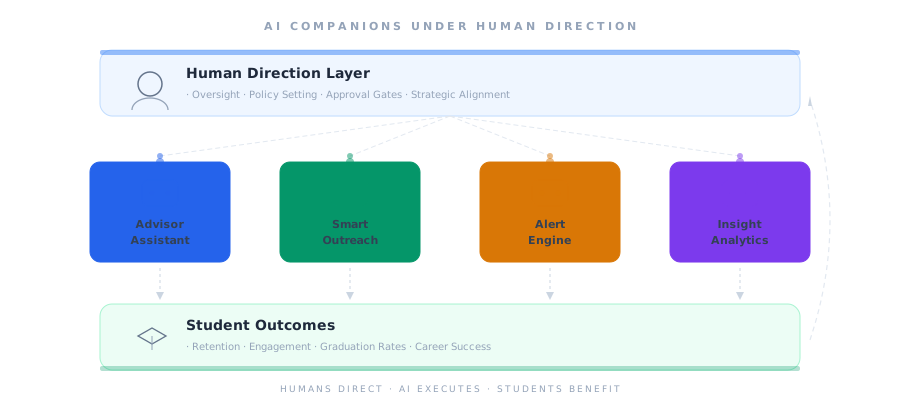
Carnegie Mellon University's COHUMAIN (Collective Human-Machine Intelligence) research framework captures this distinction precisely. The researchers caution against treating AI like another teammate. Instead, they describe it as something more nuanced: "a partner that works under human direction, with the potential to strengthen existing capabilities or relationships."
"AI agents could create the glue that is missing because of how our work environments have changed, and ultimately improve our relationships with one another."
— Professor Anita Williams Woolley, Carnegie Mellon University (COHUMAIN Framework, 2025)
That insight reframes the entire conversation. The point of AI in higher ed administration is not just operational efficiency. It is relational capacity. When an admissions officer is not buried in document processing, they have time to actually call a prospective student. When a counselor is not fielding routine queries about course registration, they can sit with the student who is quietly struggling. When a dean is not assembling accreditation spreadsheets, they can mentor a junior faculty member. The companion does not replace these relationships. It creates the conditions for them to happen more often and more deeply.
Stanford University's Graduate School of Business reinforces this from a different angle. Research by Professor Jann Spiess shows that algorithms designed to complement human decision-making consistently outperform either pure automation or unassisted judgment. The best outcomes emerge when AI handles what it is good at (volume, pattern recognition, consistency) and humans handle what they are good at (context, empathy, judgment, relationship).
"The best algorithm is the one that takes into account how a human will interact with the information it provides."
— Professor Jann Spiess, Stanford Graduate School of Business (2025)
That is the design principle: AI does not try to do the administrator's job. It handles the parts of the job that do not require an administrator, and in doing so, gives back the time and headspace for the relational work that no technology can replicate.
The Companion Model: Four Layers of Operation
Effective deployment requires clarity about what AI handles and where staff focus. Each layer flows upward. Time recovered from automation flows directly into higher-impact activities.
AI-Led Automation
Transcripts, forms, compliance, scheduling. These mechanical tasks consume enormous staff time but require no human judgment. AI handles them end to end.
AI-Augmented Analysis
Trends, risk signals, financial anomalies. AI surfaces patterns across data that no individual could track manually, giving staff actionable insight.
Collaborative Decision-Making
AI provides options; staff makes the call. The system recommends, but human professionals retain authority over every meaningful decision.
High-Touch Engagement
Mentorship, culture, relationships, with more time for it. When the mechanical burden is lifted, staff can invest deeply in the human connections that define great institutions.
Where Companions Make the Biggest Difference
AI companions deliver the most value where the gap between institutional capacity and student expectation is widest, and where mechanical work currently crowds out meaningful engagement.
Enrollment and Admissions
Personalized outreach at scale, always-on Q&A channels, document verification, and prospect scoring, so admissions staff can focus on yield-driving conversations with high-fit candidates.
- Personalized communication sequencing by prospect behavior
- Always-on Q&A channels for prospective students and families
- Document verification and application completeness checks
- Staff focus shifts to building genuine connections
Student Services and Retention
Early risk detection, routine query handling, and automated context assembly, so counselors get flagged cases with behavioral data already organized, ready for meaningful intervention.
- Behavioral signals surfaced before students disengage
- Routine queries handled without advisor time
- Staff focus shifts to mentorship and presence
Finance and Operations
Budget forecasting, procurement with built-in compliance, grant deadline tracking, and submission pre-population. These are precision-dependent tasks that consume enormous staff time.
- Automated compliance checks on procurement workflows
- Grant deadline tracking with submission pre-population
- Staff focus shifts to strategic thinking and collaboration
Academic Administration
Course scheduling optimization, faculty workload balancing, curriculum mapping, and accreditation documentation, producing draft outputs that staff review rather than build from scratch.
- Draft accreditation documents generated from institutional data
- Faculty workload balancing across programs
- Staff focus shifts to curriculum innovation and governance
Getting Past Exploring and Into Production
The biggest challenge in higher ed AI is not choosing the right product. It is getting past the exploration phase. Most institutions are stuck in what we call pilot purgatory: they have run a proof of concept, seen promising results, and then stalled. The pilot does not scale. It sits in a deck somewhere. Meanwhile, the manual work continues.
Staff resistance is real, not because people oppose technology, but because they do not have a clear picture of what changes for them day to day. Leadership enthusiasm does not translate into operational clarity. And when success metrics are not defined upfront, there is no compelling case to move from pilot to production.
The biggest risk for most institutions is not choosing the wrong AI solution. It is spending another year exploring while competitors move to production and start compounding the operational advantage.
Students, for their part, are already there. Research consistently shows that students who have used AI in their own lives are overwhelmingly positive about AI in admissions and information gathering. Positive first experiences create advocacy, which accelerates adoption institution-wide. The trust cycle starts with the first good interaction.
"In 2026, technology leaders will be focused on equipping and empowering people across their institutions to realize the net benefits of technology, AI, and data."
— Inside Higher Ed, "5 Predictions on How AI Will Shape Higher Ed in 2026" (January 2026)
Five Moves for Institutional Leaders
1. Start Where the Pain Is Most Visible
For most institutions, that is admissions personalization. Students are telling you the outreach is not working. AI companions can fix that at scale, and the improvement is immediately visible to prospects, parents, and staff.
2. Set a Production Deadline
Pick one workflow. Give it a hard deadline: weeks, not quarters. If it works, scale it. If it does not, end it and try the next one. Pilot purgatory is more expensive than a failed experiment.
3. Budget for Adoption, Not Just Software
The technology is the easy part. Training, workflow co-design, internal champions, and change management are what determine whether AI companions actually get used.
4. Connect Departments from Day One
An admissions insight that does not reach the retention team is a wasted signal. AI companions become exponentially more valuable when they share context across the institution.
5. Think in Stages, Not Switches
You do not flip a campus to AI overnight. Start with mechanical task automation, move to AI-augmented analysis, then build toward collaborative decision-making. One stage at a time.
The Bottom Line
Higher ed administration is buried under manual work: data entry, compliance checklists, mass communications that nobody reads, scheduling puzzles, accreditation paperwork. That burden is not just an efficiency problem. It is a relationship problem. Every hour spent on mechanical tasks is an hour not spent with the student who needs guidance, the colleague who needs support, or the community partner who needs attention.
AI companions can become "the glue that is missing," not replacing the human connections that define great institutions, but creating the space and time for those connections to actually happen. The technology is ready. The students are ready. The question is whether institutions will move, or keep exploring while the gap between what students expect and what they experience keeps growing.
If we lead the change, we can shape the outcome.