Introduction: The Reality of Data Silos
At many colleges and universities, data does not feel like an asset. It feels like a puzzle.
Recruitment lives in a CRM. Registration and academic history sit in a student information system. Learning engagement is captured in the LMS. Support requests and advising notes are stored in separate case management tools. On top of this, departments track their own views of "the truth" in spreadsheets stored on shared drives or personal laptops.
When the provost asks for a fall enrollment trend, analysts scramble to stitch together extracts from three systems. When the retention committee needs equity gaps by program and demographic group, someone manually exports, deduplicates, and crosswalks data from advising and the SIS. Financial aid and student success prepare parallel reports that do not match because they are using different business definitions. Everyone is working hard, yet insight is always delayed.
Nothing about this scenario is unusual. According to the EDUCAUSE Analytics Maturity Index, more than 60 percent of institutions rate themselves in the early or developing stages of analytics maturity. Surveys by the Association for Institutional Research continue to show that most campuses struggle with common data definitions, unified governance, and accessible metrics for decision-makers. Leaders want data to fuel strategic action, yet silos turn data into friction.
This white paper is written for institutions that recognize this challenge and are seeking a practical path forward. It is not about perfection or cutting-edge AI for its own sake. It is about building the foundational capability to turn every system into a contributor to a shared institutional memory and to create a pathway where analytics and AI become natural extensions of a strong data ecosystem.
Why Data Governance and Maturity Matter
In higher education, the stakes tied to analytics have increased. Recruitment volatility, accountability around student outcomes, equity and accessibility commitments, and financial pressures have made real-time, trustworthy data critical. Analytics maturity is no longer a matter of technical preference. It is part of operational resilience.
Low analytics maturity creates familiar risks:
- Metrics change depending on who reports them and how they calculate them
- Equity gaps are recognized months after intervention periods have passed
- Early alerts rely on intuition rather than evidence
- Graduation projections shift late in the cycle, impacting course planning and budget models
- Executive leadership relies on manual dashboards that cannot scale
These challenges are not the result of weak personnel or uninterested departments. They are the natural outcomes of architectures that treat systems as islands. Data maturity grows only when systems participate in a collective process rather than independent ones.
The Gartner Data and Analytics Governance Survey notes that organizations with strong governance models are twice as likely to report meaningful impact on business outcomes. In higher education, similar trends are seen. Institutions that mature from siloed reporting to shared stewardship report improved confidence in decision-making, better cross-unit collaboration, and fewer manual work cycles.
But the path from silos to stewardship is too often framed as aspirational rather than practical. Campuses do not need to jump directly to machine learning. They need a roadmap that produces early wins while building toward advanced capabilities.
That roadmap begins with a unified data hub.
Unified Data Hub: The Foundational Shift
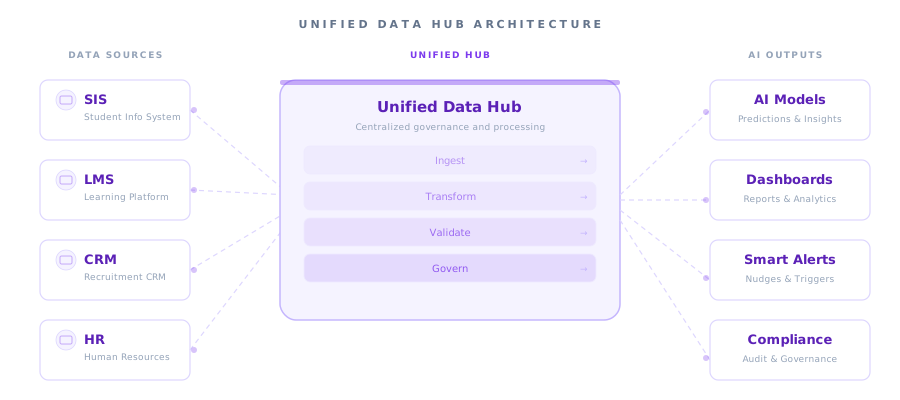
A unified data hub is not simply another database. It is a strategic architecture that brings systems together into a shared model and enables both analytics and AI.
At its core, a hub includes:
Identity unification across systems
A single representation of each student, staff member, advisor, or faculty member built from multiple IDs across SIS, LMS, CRM, housing, and other systems.
A secure, cloud-native lakehouse
Structured and unstructured data stored in an optimized form that supports both reporting and machine learning.
A common data model (CDM)
Agreed-upon definitions that ensure that metrics mean the same thing across departments. Infinize's CDM, for example, brings together identity, enrollment, academic events, engagement, support, and financial markers in a repeatable way.
The same foundation also clarifies what belongs in user-specific context versus governed institutional knowledge.
Read more about the governed knowledge layerPurpose-built analytics marts
Read-optimized tables for enrollment, retention, financial aid, course success, and equity metrics.
API and event-driven access
So dashboards, applications, and AI modules can consume data securely and consistently.
This is the architectural shift much of higher education is now making. Instead of asking every system to report everything, institutions build a stewarded space where trusted information is integrated once and then used many times.
A unified hub is not only about analytics. It also prepares the institution for the future. AI agents for advising, recruitment, career mapping, and student support require accurate histories, identity continuity, and governance. Without these, AI becomes unpredictable or unsafe. With them, AI becomes both powerful and reliable.
Roadmap: From Reporting to Insights to Intelligence
Institutions that succeed with unified data hubs do not attempt to do everything at once. Instead, they follow a phased roadmap that builds confidence and capability step by step.
Below is a practical crawl-walk-run model drawn from implementations across higher ed.
Crawl: Build the Foundation
The early phase is about visibility, consistency, and trust.
Key activities:
- Audit and inventory institutional data sources, Document where student, academic, engagement, and financial data truly reside, including shadow systems and spreadsheets.
- Design a unified schema and identity graph, Map how the same individual appears across systems. Create a controlled dictionary of fields, definitions, and calculations.
- Establish basic governance structures, Assign stewards for core data domains and define rules for quality, definitions, and access.
- Implement ingestion and quality pipelines, Begin moving initial data feeds into the hub on a scheduled basis.
Typical outcomes:
- Faster preparation of recurring reports
- Fewer manual joins between LMS, SIS, and CRM
- Early definition of "single source of truth" for core metrics
These wins build credibility and momentum. People feel the improvement immediately.
Walk: Deliver Consistent Analytics
Once the foundation is set, the hub transitions from ingesting data to enabling use cases.
Key activities:
- Create analytics marts for common questions, Enrollment trends, retention dashboards, course success, equity breakdowns, advising caseload, and student engagement.
- Adopt governed data access for analysts and leaders, Role-based access ensures security and reduces the spread of shadow spreadsheets.
- Introduce standard calculation frameworks, For example: "retention rate" has one vetted formula, not seven versions across seven units.
- Shift leadership reporting to hub-powered dashboards, Major efforts include board reports, accreditation needs, student success scorecards, and budget projections.
Typical outcomes:
- Operational reporting becomes significantly faster
- Confidence in numbers increases because reconciliations disappear
- Leaders ask better questions and want more data
At this stage, the hub is fueling decision-making. People want what it provides because they trust it.
Run: Enable AI-Powered Student Success
Advanced institutions extend the hub into intelligent, proactive support mechanisms.
Key activities:
- Publish feature tables for machine learning, Trends in engagement, course progress, assignment submissions, advising interactions, financial risk factors, and more.
- Integrate nudges and automated student outreach, Targeted reminders and agentic execution for course participation, registration, FAFSA completion, and scheduling advising.
- Deploy predictive insights for advisors and success coaches, Proactive alerts that identify students at risk earlier without replacing human judgment.
- Activate modular AI-based services, AI advising assistants, AI case triage, recruitment forecasting, career pathway mapping, workload optimization for advisors.
Typical outcomes:
- More timely support for students
- Reduced advisor workload
- Improved retention and degree progress
- Action based on evidence rather than hindsight
AI is not a separate project. When trusted data is centralized and governed, AI transitions from experimental pilot to practical day-to-day improvement in student success.
Early Wins and What They Look Like
Institutions often underestimate how rewarding the first improvements can be. Common early wins include:
- Reporting turnaround time drops from weeks to hours, IR teams stop spending time cleaning spreadsheets and start spending time analyzing.
- Fewer ad-hoc extract requests from leadership and departments, Once dashboards are trusted, the inbox gets lighter.
- Baseline equity metrics become visible and reliable, Leaders can examine outcomes by course, program, demographic segment, and time period.
- Error reduction becomes measurable, When identities and business definitions are unified, data mismatches become rare.
- Retention dashboards improve proactive intervention, Provosts and deans begin planning before the census rather than after it.
These incremental improvements build the culture shift that true governance requires. Data becomes less defensive and more collaborative. People stop debating whose number is correct and start discussing how to improve outcomes.
Looking Ahead: AI-Enabled Student Success
When the hub is working well, the institution is ready for the next frontier: AI that drives student success in tangible, ethical, and measurable ways.
Examples of AI-enabled modules that depend on unified data include:
- Advising companion systems that surface relevant insights during student meetings
- Automated nudges that remind students when actions are needed to continue progress
- Program and course planning guidance based on historical performance patterns
- Career pathways mapping aligned with student goals and local labor-market data
- Recruitment forecasting and affinity modeling to help admissions target resources
- Student success heatmaps that combine academic, financial, and engagement indicators
None of these tools must be built on day one. But all of them require the same ingredients: trusted identity unification, reliable event history, secure access controls, and clean data models. The unified hub is the cornerstone that makes scalable AI possible.
In platforms such as Infinize this evolution is framed as:
Collect → Analyze → Activate
Collect brings all data together. Analyze provides dashboards and advanced insights. Activate uses AI to make student success proactive and personal.
The most successful institutions recognize that AI is not a shortcut. It is the reward for disciplined stewardship.
Conclusion: From Stewardship to Strategic Advantage
A unified data hub is not solely a technical milestone. It is an expression of institutional maturity and shared responsibility. It signals that data is no longer owned by isolated departments but is a shared resource supporting student learning, equity, and organizational strategy.
The journey does not need to be overwhelming. It needs to be intentional.
Start with an inventory. Build identity continuity. Agree on definitions. Deliver repeatable dashboards. Grow into predictive analytics when ready. Activate AI as capability and confidence expand.
Every step strengthens governance. Every step builds toward intelligence. And every step improves outcomes for the students who trusted the institution with their aspirations.
The colleges and universities that thrive in the coming decade will not be those with the most systems or the biggest datasets. They will be the ones that transform fragmented information into stewardship, empower their people to use data confidently, and create the foundation where AI enhances the human work of teaching, advising, and supporting students.
The unified hub is not the finish line. It is the launchpad for what comes next.