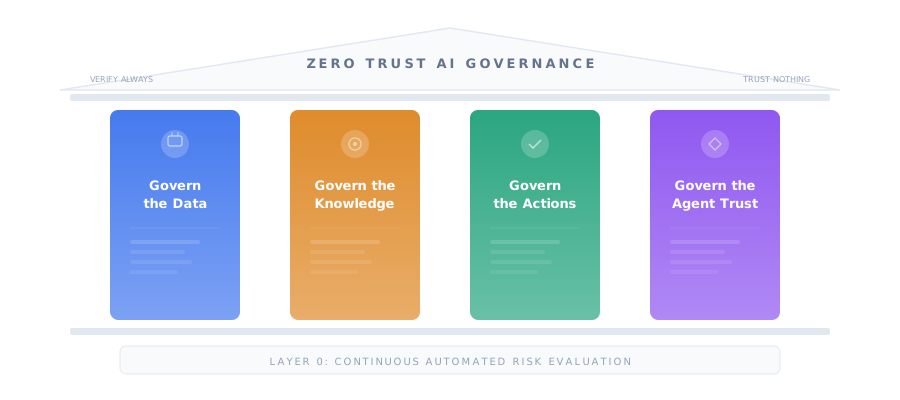
From analytics to agency
Institutions are moving quickly to put artificial intelligence to work across advising, enrollment, operations, and student success. But this new generation of AI is not merely a layer of passive insight, not the dashboards, reports, and predictive models that inform human decisions from a comfortable distance. Increasingly, institutions are deploying AI agents: autonomous systems designed to act. These agents check registration holds, schedule advising appointments, evaluate transcripts, submit requests, trigger workflow steps, and interact directly with institutional systems across the full arc of the student and staff experience.
This shift from analytics to agency represents a fundamental change in how technology operates on campus. Where a predictive model might quietly flag a student at risk of dropping out and leave the next step to a human, an AI agent can go further, identifying that risk, drafting a personalized outreach message, scheduling an advising session, and following up, all without a human initiating each step. The efficiency gains are real and significant, but so is the governance challenge they introduce.
The more capable these agents become, the more urgent the question becomes: who governs the agents?
Traditional IT governance was designed for systems where humans remained in the decision loop. Access control meant controlling who could log in and what screens they could see. But when AI agents operate autonomously, pulling from institutional data, making contextual decisions, and executing actions across systems, the governance model must evolve. The question is no longer just who has access, but what the agent is allowed to know, what it is allowed to do, and whether every decision it makes can be explained and audited.
This is where Zero Trust enters the conversation, not as a cybersecurity buzzword, but as a foundational design principle for AI governance in higher education.
What Zero Trust means for AI
Zero Trust is a well-established principle in cybersecurity, most notably formalized in the NIST 800-207 framework. Its core tenet is simple: never trust, always verify. No user, device, or system is granted implicit access. Every request is authenticated, authorized, and continuously validated.
Applied to AI agents in higher education, Zero Trust takes on a new dimension. It means that no AI agent is trusted by default, regardless of how it was built, what model powers it, or who deployed it. Every data access is verified against institutional policy. Every action is authorized at the point of execution. Every interaction is logged and auditable. This is not a bolt-on security layer. It is a governance architecture that must be woven into the fabric of how AI systems are designed, deployed, and operated.
When governance is missing, the consequences are real
EDUCAUSE’s AI governance guidance and NIST’s AI Risk Management Framework both emphasize that institutions must govern AI at the data, access, action, and audit layers, not just at the model level. A responsibly deployed chatbot is not enough if the data it draws from is ungoverned, the actions it takes are unconstrained, and the decisions it makes are invisible to institutional leadership.
Consider two scenarios that are not hypothetical. They are the predictable consequences of deploying AI agents without governance.
Scenario 1 · FERPA violation
Financial aid data exposure
A prospective student asks an institution's AI assistant about financial aid options. The assistant, pulling from an ungoverned data layer, surfaces another student's scholarship details in its response. A single misconfigured query, a missing access control, and the institution is facing a FERPA violation.
Scenario 2 · Unauthorized action
Silent course withdrawal
An advising chatbot, given broad system access to be helpful, silently submits a course withdrawal on a student's behalf, without the student's explicit approval or an advisor's review. The institution cannot explain how it happened because there is no execution trail.
These scenarios illustrate three categories of risk that intensify as AI agents gain autonomy.
Data exposure
When student data from multiple systems flows into an AI layer without proper boundaries, protected records can surface where they should not.
Unauthorized actions
An agent given broad access to be helpful can take steps no one asked for, from modifying records and submitting forms to overriding holds without proper approval.
Invisible decisions
Without a clear trail of what the agent did and why, institutions cannot explain, review, or correct the decisions it made on behalf of students and staff.
Across all three risks, governance was treated as an afterthought rather than a design principle. In a Zero Trust model, governance is enforced before the agent ever retrieves its first record or executes its first action.
Four pillars of Zero Trust AI governance
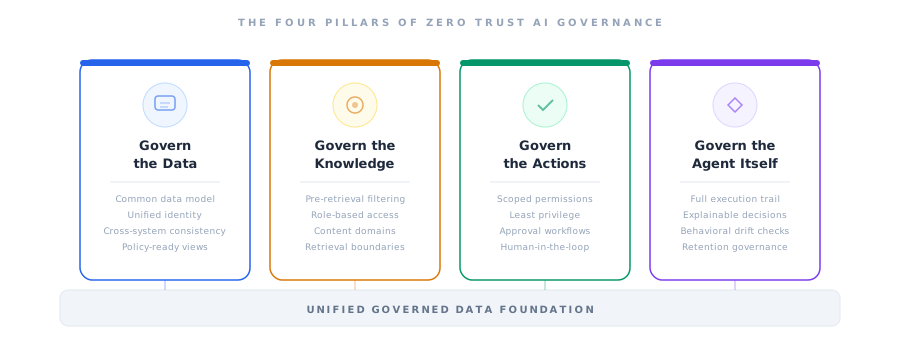
Governing AI agents effectively requires a layered approach. Based on established frameworks from NIST and emerging best practices in higher education, the following four pillars provide a comprehensive governance architecture for AI agents operating on campus.
Govern the data
Before an AI agent can be governed, the data it depends on must be governed first.
In most institutions, student data lives inside transactional systems built to capture activity, not to create shared intelligence. CRM platforms hold recruitment interactions. The SIS manages enrollment and academic records. The LMS tracks course engagement. Each system holds a fragment of the student journey, but none provides a complete, policy-ready view.
When an AI agent queries across these fragmented systems without a governed data foundation, the results are unpredictable. Records may conflict. Business definitions may diverge between systems. Identity may not resolve consistently.
A Zero Trust approach starts with a unified, governed data foundation: a common data model that standardizes core higher education entities such as learners, enrollments, courses, advising interactions, financial markers, and outcomes. It unifies identity across systems so that a student in the CRM, SIS, and LMS resolves to the same person. Without this foundation, every governance layer above it is built on unreliable ground.
Govern the knowledge
The agent cannot expose what it is never allowed to see.
The critical insight is that the control point must be applied before retrieval, not after the response is generated. If an agent can access a piece of data during retrieval, it can potentially surface that data in a response. Post-generation filtering is a patch, not a policy.
In a Zero Trust model, institutional knowledge is first partitioned into content domains (public, protected, and private), then filtered using authenticated identity and role-based policies that evaluate relationship, record scope, and sensitivity. A student queries their own holds, forms, deadlines, and academic context. An advisor retrieves cohort-specific information within their caseload. The agent only receives the subset of knowledge the user is authorized to access. This is not a content filter applied to the output. It is a retrieval boundary applied to the input.
Govern the actions
Knowing something is different from acting on it. AI agents must be governed at both levels.
The governance challenge begins the moment an agent moves from looking something up to doing something about it. A Zero Trust approach ensures that agents never receive broad system privileges. Instead, each action is made available through tightly scoped permissions, not open-ended system access. The permissions an agent has are tied directly to who is asking, what role they hold, and what the institutional policy allows in that specific context.
The core principle is straightforward: being able to see information does not mean the agent can act on it. An agent that can look up a student's registration status should not automatically be able to change that registration. Every action is checked independently, kept to the minimum level of access needed, and held to institutional policy at the moment it is performed. Where additional oversight is required, approval steps ensure that sensitive actions pass through human review before they are completed.
Govern the agent itself
Every governed agent needs a governed execution trail.
In a properly governed system, every agent interaction is tracked across the full execution path: user prompt, retrieved sources, policy checks, tool invocations, approval steps, guardrail evaluations, and final outcome. Responses include citations, giving users and staff clear visibility into the policies, catalogs, forms, and institutional records behind each answer.
This execution trace also supports human-in-the-loop governance. Sensitive actions move through approval workflows. Overrides are captured with reason codes. Complex or low-confidence cases are routed to the right advisor or staff member with context preserved.
Over time, operational metrics such as usage patterns, blocked actions, escalations, approval rates, and workflow completion signals create a measurable control layer around agent behavior. This data allows institutions to refine governance policies, identify emerging risks, and demonstrate compliance to accreditors and regulators.
Governance must also account for behavioral drift. An AI agent that performs well today may behave differently after a model update or a change in the data it draws from. Institutions need a way to test agent behavior against known baselines, verifying that the same question still produces a safe, accurate, and policy-compliant response over time, not just at the moment of deployment.
Finally, logging everything creates its own responsibility. Institutions must define how long interaction records are retained, who can access audit trails, and whether students can request that their conversation history be deleted. A governance model that captures every interaction but never addresses retention or access rights is incomplete. The audit trail itself must be governed alongside broader institutional commitments to security and privacy.
Questions every institution should ask
As AI agents become more capable and more embedded in institutional workflows, CIOs, data leaders, and IT governance teams should evaluate their readiness against these questions.
- 01
Does our AI operate on a unified, governed data foundation, or is it pulling from fragmented, ungoverned sources?
- 02
Is data access controlled before retrieval, or are we relying on post-generation filters to catch exposure?
- 03
Does our AI have access only to the data each user is authorized to see, based on their identity and role?
- 04
Can our AI act on institutional systems, or only retrieve information, and who controls that boundary?
- 05
Can we trace every AI decision back to the data, policies, and logic that informed it?
- 06
Do we have human-in-the-loop controls for sensitive or high-stakes AI actions?
- 07
If one agent hands off to another, does governance follow the chain, or does the second agent inherit unchecked access?
- 08
If the governance layer goes down, does the agent stop acting, or does it proceed without checks?
- 09
Do students know when they are interacting with AI, what data it can see, and how to opt out?
- 10
Are we testing agent behavior over time, or only at the point of deployment?
If the answer to any of these questions is uncertain, the institution’s AI governance framework has gaps that will widen as agents become more capable.
From AI capability to institutional control
AI agents will increasingly operate across institutional data, workflows, and student-facing experiences. For CIOs and data leaders, the mandate is not just to deploy them, but to govern them. Zero Trust for AI is ultimately a discipline of controlled access, constrained execution, and continuous transparency. The institutions best positioned to scale AI responsibly will be the ones that build these principles into their data foundations, policy frameworks, and operational workflows from the start.