Most institutions measure student success in annual cycles. Retention is reviewed year over year. Graduation rates shift gradually. These outcomes are essential indicators of institutional performance, but they share a common limitation: they are lagging measures.
By the time retention declines, the signals that influenced it have already accumulated.
Student momentum, however, moves far more quickly. It shifts week to week, sometimes day to day. A missed assignment. A failed gateway assessment. A delayed registration. An unresolved financial hold. Individually, these moments may appear minor. Collectively, they determine persistence.
When institutions respond slowly to early academic and operational signals, manageable friction becomes structural attrition.
Student success is not only a matter of strategy. It is a matter of speed.
Retention is the result. Leading indicators move first.
Retention reflects what has already happened. The real leverage lies in the indicators that shift earlier. Those indicators are measurable:
- DWFI (Drop, Withdrawal, Fail, Incomplete)
- Credit accumulation velocity
- Gateway course performance
- Registration and financial hold delays
- Advising response time
- Engagement declines in LMS activity
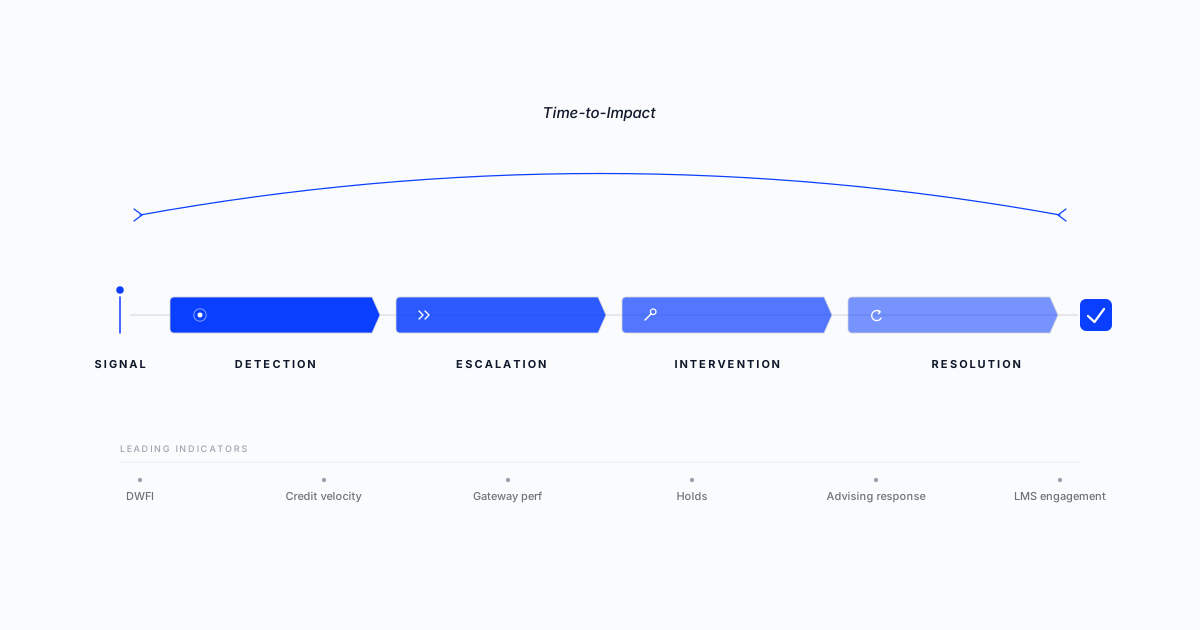
Each of these signals movement in student momentum before retention rates change. They reveal where friction is forming and where intervention is still possible. But measurement alone does not improve outcomes. What matters is how quickly an institution moves from signal to resolution, and that is what we call Time-to-Impact.
Time-to-Impact has four speeds: detection, escalation, intervention, and resolution. Each one defines how long a student spends in friction before momentum can be restored.
Detection speed
How quickly do you see the signal?
Academic, engagement, and operational data often live in separate systems. SIS, LMS, CRM, advising platforms, and web behavior each hold part of the picture. Fragmentation delays awareness.
Infinize’s Common Data Model, built on a secure lakehouse, unifies SIS, LMS, CRM, and web data into a single trusted schema. Standardized identities and near real-time pipelines let institutions detect academic and operational shifts as they occur.
You cannot intervene early if detection is late. Detection speed sets the ceiling for everything that follows.
Escalation speed
How fast does the signal reach the right person?
Detection without ownership creates delay. A DWFI pattern or engagement drop must move immediately to the responsible advisor or success leader, not sit in a dashboard awaiting review.
Infinize’s Alerts & Nudges converts early risk and momentum signals into structured playbooks. Signals are routed automatically based on role, with impact tracking embedded into the workflow.
Escalation speed improves when routing is predefined and automated, not manual.
Intervention speed
How quickly does meaningful support occur once risk is identified?
Advisors reconstruct student history. Staff toggle between systems. Students navigate multiple portals. Infinize reduces intervention latency through a layered set of agents that work within the same data foundation:
- Universal Agent lets staff ask and act across campus systems, checking holds, initiating forms, scheduling advising automatically, with retrieval and action capabilities, audit trails, and human-in-the-loop controls.
- Productivity Agents summarize student history, generate structured outreach templates, track tasks, and manage caseload priorities.
- Academic Planning Agents validate term-by-term degree plans that honor prerequisites, load constraints, and scheduling realities.
- Major Exploration Agents align student interests and strengths with program fit, preview first-term plans, and provide advisor-ready summaries.
- Transfer Credit Evaluation Agents support AI-assisted equivalencies, automated program rule mappings, and pathway clarity that reduces credit loss.
- Career Pathway Agents connect coursework and skills to roles, micro-credentials, and internship opportunities, reinforcing long-term alignment.
Intervention speed improves when action is embedded within workflow, not scattered across platforms and manual coordination.
Resolution speed
How quickly is the underlying issue actually resolved?
Detection, escalation, and intervention are only meaningful if the barrier itself is removed. Yet many institutions measure when an alert was created, not how long it took to resolve the issue behind it. Was the financial hold cleared? Did academic performance stabilize? Did credit accumulation return to pace? Without visibility into resolution, institutions cannot distinguish activity from impact.
Infinize enables closed-loop visibility through its secure lakehouse analytics and Campus 360 insights. Institutions can monitor whether risk signals decline following intervention and how quickly momentum is restored. This transforms resolution from an assumption into a measurable outcome.
Resolution speed ultimately defines true time-to-impact. Institutions that measure how long it takes to remove friction are better positioned to reduce it.
What this means for your institution
Retention is a lagging outcome, and leading indicators move well before it. But insight without speed does not change results. The institutions that outperform their peers will not be the ones with the most dashboards or the most reports. They will be the ones that systematically compress the distance between signal and action, and between action and resolution.
The discipline of detection, escalation, intervention, and resolution must operate as a coordinated system, not as isolated efforts. Student success is ultimately a function of how quickly institutions convert early signals into measurable improvement. Time-to-impact is emerging as the operational metric that separates intention from sustained performance.
Infinize supports this shift by unifying institutional intelligence and embedding action directly into workflow, simplifying the path from insight to impact across campus.